


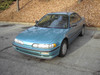
on my 90 integra the battery light turns on when i rev over 4500 rpms. does it mean the alternator or the battery is going bad?


 battery light turns on when reving high
on my 90 integra the battery light turns on when i rev over 4500 rpms. does it mean the alternator or the battery is going bad?
90 Integra....Sold
96 Jetta VR6...current money pit


Check your Alt Ground. If nothing, sounds like its time for a new Alternator
-Super cool .gif TO UNBAN JITB, JM, Buttons AND NEMISIS here-

That's usually a bad diode in the alternator.
Go to any auto parts store like Autozone or Pep Boys and they will check it for you for free.

Sounds like a good idea. ^^^^

yea it sounds like the alternator... try not to get a cheap replacement. I got one from advanced (not even the super cheap, but middle of the line replacement) and it lasted 4 months.
Land Rover LR3 HSE
yea well i got the battery tested at autozone today and it is fine, to get the alternator tested dont i have to take it out of the car?Originally Posted by Jaimecbr900
also new info, when it was dark i found out that when the battery light turns on the all of the lights get brighter, i will check the ground first thing tomorrow morning.
90 Integra....Sold
96 Jetta VR6...current money pit

my battery light came on at idle, but not ever idle, after a week, the car started dieing on the way to work one morning. one thing started dieing at a time, clock, radio, gauges, motor. haha. i made it barely home. ALTERNATOR DIED.
www.MSSRACING.com - 99 Civic CX - Best ET: 9.53 / Best MPH: 160 - Competition Clutch - Arias Pistons - Coatings M.D. - Mahle-Clevite - ebtec - AHobbs Racing - JKOBD - TDC Performance
Daily D: 2007 Dodge 2500 MEGA CAB, Cummins Turbo Diesel


alternator bolt in the bracket loose or belt about to break. same thing happened to me. might be the same for you.

you dont have to take the alt off to test it.
The EMPIRE

alternator ftw
#1. You do NOT have to take the alternator out to test it. If they told you that at Autozone, RUN to a different place to get it tested IN the car.
#2. BEFORE getting it tested and to avoid looking like a true newb, check to be sure that the belt is tightened and/or not falling apart. Check the grounding cable and the plug to be sure neither is loose or off.
#3. What part of town are you in? If you are in Gwinnett, I can send you to a shop to get it all done if need be. They are in my sig.
#4. You should do this ASAP. Usually alternator problems only get worse and they do so quickly. I wouldn't drag it out unless I love pushing cars down the road.
Good luck.
i was at a place today to get it tested and its good the belt is also tight and still in good condition, i just didnt get to check the ground cables since it really hard to get to from the top. right now just trying to drive the car as little as possible and keeping it at low rpms, im sure its a ground wire
90 Integra....Sold
96 Jetta VR6...current money pit

How do you get it tested? Do they just check the voltage when the car is running, or do they actually test the alternator? Cause I can check my own voltage thank you...
If I've got like everything on and I'm sitting there idling my car will dip down to about 10 volts and my headlights and stuff dim a little...would replacing the alt with a higher amp alt solve this?
To test an alternator, it is tested with the car on at both idle and above 2k RPMS. Your voltage should NEVER drop down to 10. Something is wrong with that picture. Think about it. The battery alone has 12....
Anyway, usually the procedure goes a little like this:
1. Someone hooks up some leads onto your battery.
2. You check the battery first. If it's good, then the alternator gets checked.
3. The car is running at idle. Depending on the tester, manual or electronic, it takes a reading of voltage at idle.
4. Car then gets rev'd up to above 2k RPMS and held there steady, not revving up and down...steady. Another reading is taken. That reading usually puts a load on the battery and then it subsides.
5. Results come out.
Rule of thumb is this:
After a car is up to operating temp, your voltage at idle should not drop below 13.0-13.3V. Above idle, same scenario, your voltage will jump up somewhere past 14V and stay there based on RPMS and load. What AMPS the alternator puts out is all a function of a combination of RPMS and internal construction. "High output" alternators are notoriously finicky. Some work better than others. Some are nothing more than a smaller pulley on a stock alternator (makes it rev a lot higher and thereby sometimes putting out more amps). Some are the real deal. Usually the price will be an indicator of which one you have. Bottomline is that you only need a "high output" alternator IF you have the load that needs it. Big stereo systems, hydraulics, lighting, etc. Some cars already come with larger output alternators from factory too.
Hope this helps.
I still think it's the alternator BTW.
well now i have all the time in the world to find out what went wrong cause my clutch went out too
90 Integra....Sold
96 Jetta VR6...current money pit
Thing is, the car has ALWAYS been like this. I've changed the battery once like a year ago, and the alternator doesn't seem to be going bad because it always has the same amount of volts. Like, when I go to start it in the morning it'll be at like 10 volts. Idling with no accessories on it'll be right at 12v. If I rev it up it goes to like 13. Load I put on it though makes it go much lower. I always thought it was because the car is ancient and it probably has bad grounds and maybe a short.
 Posting Permissions

 Reply With Quote


